

Views: 0 Author: Site Editor Publish Time: 2026-10-16 Origin: Site


Tearing open a monthly utility envelope to find a doubled water bill triggers instant panic. Most homeowners immediately assume the meter is broken. This frustration makes perfect sense. The measurement device acts as the definitive financial link between a household and the municipal supply. It dictates your exact payment and plays a vital role in personal budgeting.
While a brand-new unit delivers exceptional precision, it remains a mechanical instrument bound by the laws of physics. Over years of continuous operation, environmental factors like sediment accumulation take a heavy toll. Internal engineering plays a massive role in long-term reliability. This guide breaks down baseline accuracy standards and compares internal mechanisms from a frontline engineering perspective. We will also outline actionable field testing steps and explain the protocol for handling faulty readings.
Baseline Precision: A high-quality unit typically measures usage within a strict ±1.5% to ±2% margin of error to meet rigorous industry standards.
Age Degrades Accuracy: As mechanical components age, internal friction increases. This wear generally causes the device to read slower and under-register actual volume.
Hidden Leaks vs. Hardware Faults: Drastic spikes in monthly costs are statistically much more likely to stem from hidden plumbing leaks rather than a malfunctioning dial.
Internal Engineering Matters: The specific design dictates sensitivity to low flows and overall resistance to grit.
DIY Diagnostics: Homeowners can perform objective, evidence-based tests at home before requesting an official inspection from their local provider.
Precision is the primary metric for evaluating utility infrastructure. Organizations like the American Water Works Association and the International Organization for Standardization rigorously define these measurement standards. A newly installed Residential Water Meter operates within a tight accuracy margin of 98.5% to 101.5%. For every 100 gallons flowing through your plumbing, the dial must register between 98.5 and 101.5 gallons. This tight tolerance ensures fair billing for the consumer and accurate resource tracking for the municipality.
However, baseline precision degrades over time. A standard mechanical unit typically lasts ten to fifteen years. Local water quality and total processed volume heavily influence this lifespan. Internal components constantly interact with fluid, making slight mechanical wear inevitable. By year ten, calibration often drifts outside original parameters, especially when measuring very low flow rates.
From a utility management perspective, this degradation creates non-revenue water. Aging hardware almost universally under-registers usage. This discrepancy between treated volume at the plant and billed volume causes staggering financial losses for municipalities. Consequently, proactive infrastructure replacement has become a major focus for water companies.
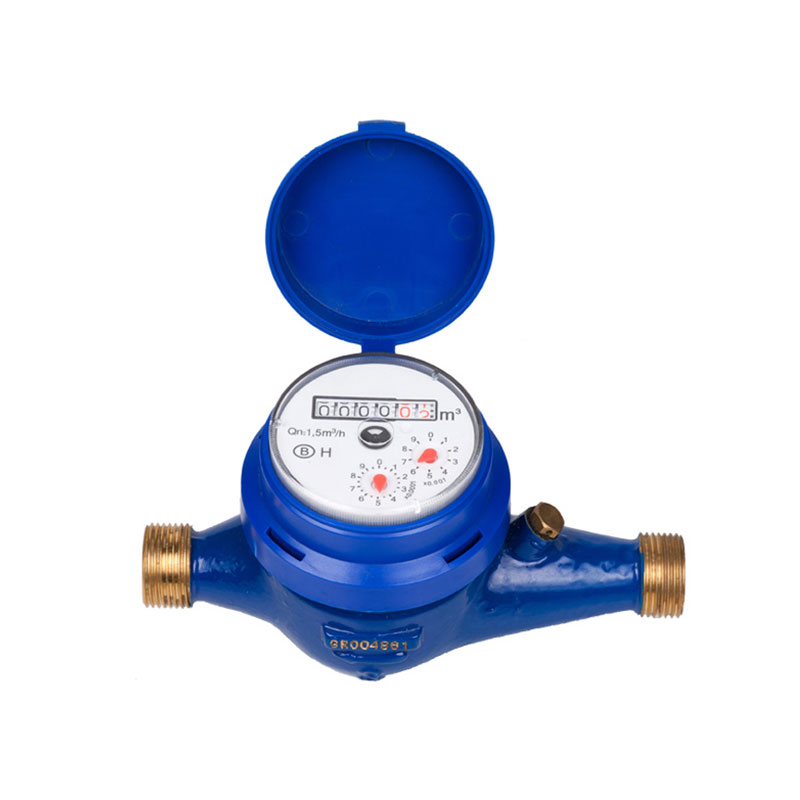
Understanding the engineering behind the dial reveals how a unit maintains precision over years of service. Residential applications rely on three primary mechanical designs. Each possesses distinct operational characteristics and vulnerabilities.
The single-jet design relies on a straightforward velocity principle. A concentrated water stream hits an internal impeller from one direction. The turbine spins, and the rotation speed correlates directly with the fluid volume passing through the chamber.
While cost-effective and compact, it carries a structural flaw. The asymmetrical hydrodynamic load causes uneven wear on the central shaft and bearings. Over time, increased friction degrades long-term accuracy. This makes the unit far less sensitive to minor plumbing leaks compared to balanced alternatives.
Engineers developed the multi-jet mechanism specifically to solve asymmetrical wear. Fluid enters the measurement chamber through multiple surrounding ports. This creates a symmetrical, uniform flow that spins the impeller evenly from all directions.
Because the physical load is distributed evenly, internal bearings experience minimal stress. A high-quality Multi-jet Water Meter like the LXSG-15E5 to 20E5 series utilizes this robust design. These units feature a durable brass body, a magnetic drive to lower transmission resistance, and a vacuum-sealed register to keep the dial clear from frost. They maintain their ±1.5% precision margin over a much longer period and exhibit superior resistance to sediment buildup.
Unlike velocity-based turbines, a volumetric piston meter measures exact physical volume. An oscillating piston sits inside a fixed-volume cylindrical chamber. Every rotation represents a specific, known amount of displaced fluid.
This approach offers extreme sensitivity. It easily detects microscopic flows like a weeping faucet. In contrast, the clearance between the piston and chamber walls is incredibly tight. Heavy sediment or mineral grit can quickly jam the piston, causing rapid calibration loss or complete system failure.
Meter Type | Measurement Principle | Sediment Resistance | Best Application Scenario |
|---|---|---|---|
Single-jet | Velocity Turbine | Moderate | Budget-conscious, compact residential spaces |
Multi-jet | Balanced Velocity | High | Long-term residential use, varying water quality |
Volumetric Piston | Direct Displacement | Low | Highly filtered municipal water, low-flow tracking |
When facing an astronomical bill, families immediately assume the dial is running fast. The physics of mechanical measurement strongly contradicts this popular myth.
Traditional units rely on moving physical parts like gears and impellers. They are strictly bound by the laws of friction. As components age or accumulate hard water scale, internal resistance naturally increases. This added friction acts as a brake. It slows the moving parts down relative to the actual fluid flow.
Due to this mechanical reality, aging devices almost always under-register usage. They require more pressure to turn the dial than when newly installed. Older infrastructure typically reads in favor of the homeowner by recording slightly less fluid than was actually consumed.
Specifically, there are rare scenarios where a unit registers higher than actual usage. If neighborhood line repairs introduce significant air pockets into the plumbing, the rushing air can spin the impeller. This temporarily inflates the reading. Manufacturing defects in gear ratios are another possibility, though rigorous factory batch testing makes this highly improbable.
Compromised precision stems from both internal mechanics and external environmental factors. Several culprits degrade performance prematurely.
Age and mechanical wear remain the most ubiquitous causes. Continuous daily operation degrades plastic, brass, and synthetic components. Gears strip and bearings wear out. The mechanism loses tight tolerances, leading to sluggish rotation.
Furthermore, local water quality plays a massive role. Homes in hard water regions face calcium and magnesium buildup. This stubborn scale binds internal moving parts. Aging municipal lines also carry microscopic rust and sand. In a Single-jet Water Meter, debris can easily obstruct the single inlet port, skewing flow dynamics.
Improper installation immediately compromises precision. Velocity-based models require smooth, laminar flow. Placing a unit too close to a sharp pipe bend or valve creates turbulence that disrupts the impeller. Mounting a horizontal device in a vertical position alters the gravitational load on internal bearings, ruining calibration instantly.
Before calling a plumber or disputing a bill, homeowners should perform objective field tests. These practical steps help determine if the hardware is truly at fault.
The Leak Indicator Check
Most fast meter complaints stem from hidden plumbing leaks. Turn off every water source inside and outside the house. Locate your meter box and check the low-flow leak indicator. This is usually a small red triangle or a sweeping gear on the dial face. If you are certain nothing is running but the indicator moves, you have a leak. The device is functioning perfectly and simply recording escaping fluid.
The Toilet Dye Test
Silent toilet leaks drive unexpected usage spikes. A warped flapper valve silently wastes hundreds of gallons daily. Remove the toilet tank lid and add dark food coloring to the reservoir. Wait thirty minutes without flushing. If dyed water appears in the bowl, a silent leak is actively driving up your monthly costs.
The DIY Bucket Test
If you rule out leaks, perform a basic volumetric test. Ensure no fixtures are running. Write down the exact dial reading and the sweep hand position. Fill a standard, clearly marked five-gallon bucket using a nearby hose spigot. Return to the box and check the new reading. The dial should advance by exactly five gallons. If the reading jumps by ten gallons, you have solid grounds to request an official inspection.
If your bucket test reveals a glaring discrepancy, contact your provider. However, approach this formal dispute process with a clear understanding of standard utility policies.
Water companies rarely test equipment while it remains in the ground. They remove the disputed unit and install a temporary replacement. The old hardware goes to a laboratory for an official bench test. Technicians run precise fluid volumes through the chamber at low, intermediate, and high flow rates. They compare the results against calibration standards to determine the exact error percentage.
Requesting an official bench test carries financial risk. Historical data shows the vast majority of disputed units are either accurate or under-registering. Utilities frequently charge a testing fee to deter frivolous complaints. If the bench test proves the device is over-registering, the utility waives the fee and adjusts your bill. In contrast, if the hardware proves accurate, you remain responsible for both the testing fee and the original high bill.
Analyzing recent shifts in municipal infrastructure reveals a massive transformation in water measurement. Driven by increasing freshwater scarcity and the staggering financial burden of non-revenue water, the industry is rapidly transitioning away from basic mechanical reading. We are witnessing a massive surge in Advanced Metering Infrastructure and Automated Meter Reading technologies. Utilities now prioritize smart grids that pair highly calibrated measurement bodies with wireless transmission capabilities. This technological leap eliminates manual reading errors. It also empowers consumers with real-time data analytics, allowing for instantaneous leak detection before a minor drip escalates into a catastrophic monthly bill.
For property developers, utility contractors, and proactive homeowners, understanding the hardware lifecycle ensures fair billing. Proactive replacement remains the best strategy for long-term reliability. Industry best practices suggest swapping mechanical residential units every ten to fifteen years. Beyond this window, municipal revenue loss from under-registration far outweighs the cost of new hardware.
When undertaking an upgrade, selecting an Accurate Water Meter tailored to specific environmental conditions is crucial. For regions grappling with hard water or minor sediment, a highly durable multi-jet design offers the best balance of precision and wear resistance. Look for models featuring magnetic drives and anti-magnetic tampering protections to ensure consistent data integrity. For pristine, highly filtered systems where tracking every drop is paramount, a volumetric design serves as the preferred choice.
A residential measurement device is a highly precise instrument designed to ensure equitable billing. While it is natural to blame the hardware during a sudden bill spike, hidden plumbing leaks are almost always the true culprit. As mechanical devices age, they naturally under-report usage due to internal friction, which actually favors the consumer.
Understanding how your system operates empowers you to make informed maintenance decisions. Recognizing the mechanical differences between a Piston Water Meter and a multi-jet model is essential for proper application sizing and long-term durability.
Take a few minutes today to check your property's leak indicator and perform a quick toilet dye test. For utility managers and contractors evaluating current infrastructure, exploring high-quality replacement options prevents ongoing revenue loss. If you are looking to upgrade your municipal or residential network, browse the premium selection of multi-jet and smart measurement solutions at China Water Meter to guarantee transparent billing for every household.
Typically, a standard mechanical unit lasts between ten and fifteen years. The exact lifespan depends heavily on local water quality and total processed volume. Microscopic sediment and hard water scale accelerate internal wear, causing the meter to lose calibration sooner.
Yes. Mechanical measurement devices record volume, regardless of whether it is liquid or gas. If a mixture of air and water passes through the plumbing, the air can spin the internal impeller rapidly. This results in a temporarily inflated reading.
In most municipalities, the local utility company owns the device. They assume full responsibility for maintenance, testing, and replacement. The homeowner maintains the plumbing infrastructure leading from the box into the house and must keep the surrounding area clear of debris.
Generally speaking, yes. Modern ultrasonic and electromagnetic digital models contain no moving internal parts. This fundamental design difference eliminates mechanical wear and internal friction. They remain exceptionally reliable and highly sensitive over their entire operational lifespan.
Look directly at the dial face. The unit of measurement is always printed on the register. It will clearly state "Gallons", "U.S. Gallons", or "Cubic Feet". One cubic foot equals exactly 7.48 gallons, which is a critical conversion factor when calculating your actual usage and comparing it to your utility bill.
Not necessarily. While a severely jammed piston or a clogged inlet screen on an aging unit can restrict flow, sudden pressure drops are more commonly caused by failing pressure reducing valves, closed main shutoff valves, or municipal supply issues. A licensed plumber should evaluate the system to isolate the exact pressure bottleneck.
