

Views: 0 Author: Site Editor Publish Time: 2026-08-12 Origin: Site


Hidden water leaks account for significant operational waste, property damage, and utility costs long before visible signs appear. Traditional manual meter reading relies on historical consumption data. This means continuous flows and micro-leaks—like running toilets, dripping showerheads, or faulty irrigation valves—often go undetected for entire billing cycles. The result is compounded financial and infrastructural damage. Upgrading to Advanced Metering Infrastructure (AMI) and deploying a Smart Water Meter shifts leak management from a reactive discovery process to a proactive, automated alerting system based on real-time flow data. You stop relying on monthly estimates and start tracking actual fluid movement. This approach provides immediate visibility into your plumbing network, allowing you to address faults before they escalate into major structural failures.
Algorithmic Detection: Smart meters identify leaks by detecting continuous flow over specific time intervals, triggering automated alerts when usage fails to return to a baseline zero-flow state.
High-Resolution Accuracy: Solid-state technologies (like ultrasonic sensors) capture minute low-flow rates that traditional mechanical meters miss, empowering aggressive water conservation.
Real-Time Visibility: Wireless data transmission enables hourly or daily tracking, drastically reducing the time-to-discovery for both catastrophic pipe bursts and silent fixture leaks.
Deployment Considerations: Selecting the right leak detection water meter requires evaluating connectivity protocols, battery lifespan, and software integration capabilities to ensure reliable ROI.
Defining a leak from a metering perspective requires establishing what normal consumption looks like. A catastrophic pipe burst presents as a massive, sudden spike in volume. These are easy to spot. However, most hidden leaks manifest as uninterrupted, low-volume flows. Automated detection succeeds when the system accurately differentiates between authorized usage and constant unauthorized drainage. We rely on data intervals to make this distinction.
Modern metering systems establish a baseline of normal usage first. They record standard consumption peaks during daytime hours and expected lulls overnight. The core logic relies on continuous flow triggers. The system flags an anomaly if water flows constantly for 24 hours without a single zero-read. If a building is occupied, water use fluctuates. People wash hands, flush toilets, and run dishwashers. Between these events, the flow must drop to absolute zero.
This continuous-flow logic catches notorious silent wasters. Shower leaks, stuck toilet flappers, and underground pipe faults easily evade visual inspection. Traditional meters ignore these slow drains because the flow rate falls below their mechanical starting threshold. Advanced algorithms recognize that healthy plumbing systems must occasionally reach a state of absolute zero flow. When the meter records 96 consecutive 15-minute intervals with flow greater than zero, it triggers a continuous flow alarm.
You can adjust these algorithmic parameters based on the facility type. A hospital operates 24/7 and might rarely see a zero-flow state on the main line. In this scenario, the algorithm looks for flow that never drops below a specific baseline threshold, rather than absolute zero. The software adapts to the operational reality of the building.
Electronic meters measure flow rates down to fractions of a gallon per hour. Mechanical meters simply cannot register these micro-leaks. Internal friction within mechanical chambers allows small amounts of water to slip through unrecorded. A standard mechanical meter might require 0.25 gallons per minute (GPM) just to start turning the dial. Solid-state sensors eliminate this physical limitation, reading flows as low as 0.01 GPM.
Capturing these micro-leaks hits municipal water conservation targets. Every unrecorded drop contributes to massive environmental impact over time. High-resolution measurement ensures utilities and facility managers account for every ounce of water moving through the infrastructure. You stop losing treated water to the ground. This precision allows you to identify a weeping valve before it becomes a full blowout.
Common Leak Flow Rates and Detection Thresholds
Leak Source | Estimated Flow Rate (GPM) | Mechanical Detection | Solid-State Detection |
|---|---|---|---|
Dripping Faucet | 0.01 - 0.05 | Fails to register | Detects immediately |
Running Toilet | 0.10 - 0.50 | Inconsistent | Detects immediately |
Stuck Irrigation Valve | 1.00 - 5.00 | Detects | Detects immediately |
Main Line Fracture | 10.00+ | Detects | Detects immediately |
Data collection means nothing without rapid transmission. Advanced Metering Infrastructure utilizes wireless signals to transmit data at hourly, daily, or weekly intervals. Telemetry modules push this information securely to central servers. You do not have to wait 30 days for a meter reader to walk the route. The network handles the heavy lifting.
This data feeds directly into utility dashboards or consumer applications. System administrators configure custom thresholds within the software. When the meter detects a continuous flow violation, the system triggers immediate SMS or email alerts. You dispatch maintenance teams before minor leaks cause structural damage. The transmission payload includes the meter ID, timestamp, flow rate, and specific alarm flags.
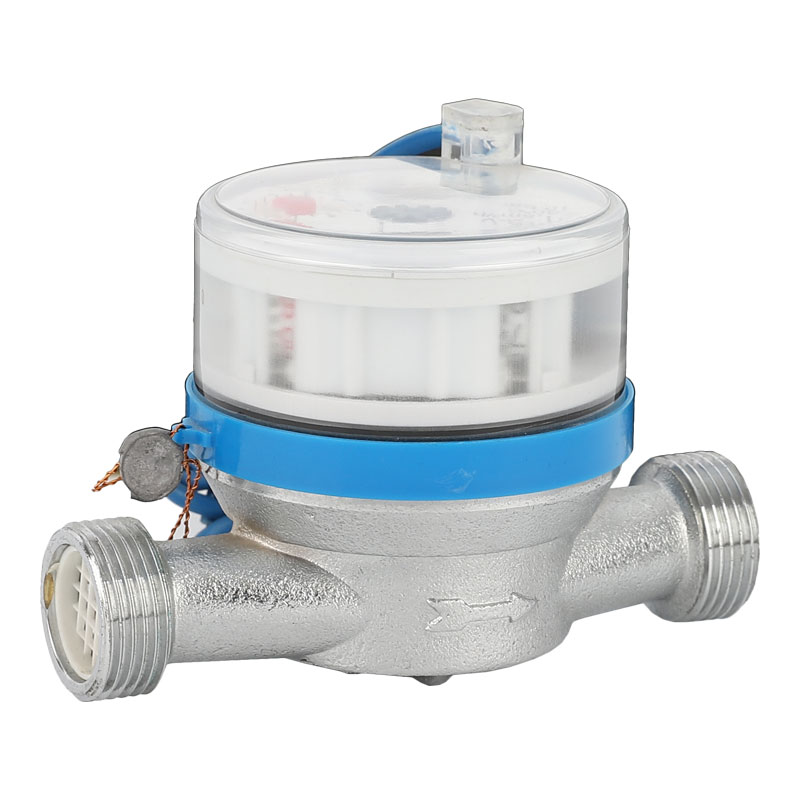
Automated alerts provide the first warning. Field verification confirms the issue. Facility managers and maintenance personnel manually interact with the hardware to pinpoint active leaks. You do not need specialized diagnostic equipment to verify the alert. A systematic approach isolates the fault quickly.
Isolate the Plumbing System: You must establish an expected zero-flow state. Shut off all internal and external water fixtures. Turn off ice makers, HVAC makeup water valves, and irrigation systems. Ensure no authorized water consumption is occurring anywhere on the property. In commercial buildings, check cooling tower feeds and boiler makeup lines.
Check Bypass Valves: Ensure all bypass valves around the main meter are fully closed. An open bypass allows water to flow around the measuring chamber, creating false readings and masking downstream leaks.
Access the Meter Interface: Locate the physical meter installation. Depending on the deployment environment, this may be in a basement, utility closet, or exterior pit. Clear away any debris or standing water. Alternatively, log into the connected AMI dashboard via a mobile device to view real-time telemetry while standing at the main shutoff valve.
Utilize Optical Sensors: Many modern digital meters feature an optical sensing button. Tap this sensor to wake up the digital display. Toggle through the menu options until you reach the real-time flow rate screen. This screen displays current water movement rather than total historical volume. You are looking for the instantaneous flow rate.
Interpret the Data: Observe the digital readout carefully. You isolated the plumbing system in step one. Therefore, the expected flow rate is absolute zero. If the digital display shows any number greater than zero, an active, hidden leak exists downstream. You must now inspect individual zones. Close isolation valves one by one. When the meter drops to zero, you have found the leaking zone.
Hardware selection dictates detection capabilities. Different environments require specific measurement technologies. Understanding the physics behind each meter type ensures optimal deployment. You cannot install a residential meter in an industrial facility and expect accurate leak detection.
Ultrasonic devices represent the standard for a Leak Detection Water Meter. These solid-state meters use high-frequency sound waves to measure fluid velocity. Piezoelectric transducers send acoustic signals with and against the water flow. The transit time difference calculates the exact volume passing through the pipe. Water moving downstream accelerates the sound wave, while water moving upstream slows it down.
They feature absolutely no moving parts. This eliminates mechanical wear and tear. Ultrasonic meters maintain sustained accuracy over their entire lifespan. They offer superior low-flow detection, making them ideal for catching micro-leaks in residential and commercial settings. Grit, sand, and pipe scale pass right through the measuring tube without damaging internal components or jamming a rotor.
Electromagnetic meters utilize Faraday’s Law of Induction. As water flows through a magnetic field, it generates a voltage proportional to its velocity. Electrodes capture this voltage to determine flow rates. The faster the water moves, the higher the voltage generated across the measuring tube.
These meters excel in specific commercial or municipal applications. They handle dirty water, raw sewage, and high-volume distribution lines effortlessly. While highly accurate, they typically require more power than ultrasonic variants. You often see them on large transmission mains rather than individual residential service connections. They require a conductive fluid to operate, which standard drinking water provides.
Many utilities utilize a hybrid approach. They attach digital transmitters to traditional positive displacement or turbine meters. This upgrades legacy infrastructure to support automated reading without replacing the heavy brass body. You bolt a radio endpoint onto the existing register.
However, this approach carries distinct trade-offs. You gain wireless data transmission, but you remain limited by mechanical physics. Low-flow sensitivity degrades over time as internal components wear down. Mechanical retrofits often fail to detect the micro-leaks that solid-state meters catch easily. The transmitter might send data every hour, but if the mechanical chamber fails to register a 0.1 GPM leak due to worn nutating discs, the transmitted data is useless.
Comparison of Metering Technologies
Technology Type | Measurement Method | Low-Flow Sensitivity | Mechanical Degradation |
|---|---|---|---|
Ultrasonic | Acoustic transit time | Exceptional | None (Solid-state) |
Electromagnetic | Magnetic induction | High | None (Solid-state) |
Mechanical Retrofit | Physical displacement | Moderate to Low | High (Moving parts) |
Selecting the right hardware goes beyond basic specifications. You must align technical capabilities with operational goals. Evaluate meters based on features, network compatibility, and industry standards. A meter that works perfectly in a high-rise building might fail completely in a rural pit installation.
Map specific software features directly to operational outcomes. Customizable alert thresholds allow you to differentiate between a dripping faucet and a burst main. You can set a 5 GPM threshold for immediate burst alerts and a 0.1 GPM threshold for 24-hour continuous flow alerts. Historical usage graphs help identify seasonal waste patterns, like overwatering during summer months.
These features drive tangible results. Early detection reduces monthly utility bills. Rapid response prevents catastrophic property damage. Accurate data collection ensures you achieve strict municipal conservation goals. You stop guessing about water usage and start managing it actively based on hard data.
Evaluate transmission protocols carefully. Cellular options like LTE-M and NB-IoT leverage existing telecom infrastructure. They work well for distributed, single-facility deployments. You do not need to build your own network. LoRaWAN offers excellent long-range capabilities for campus environments. You install a few gateways to cover hundreds of acres. Proprietary RF networks often suit dense municipal rollouts where the utility wants complete control over the infrastructure.
Network choice directly impacts deployment scale. A municipality-wide rollout requires robust, penetrating signals to reach meters in deep pits. Sub-GHz frequencies like 900 MHz penetrate concrete and soil much better than 2.4 GHz signals. Single-facility upgrades might only require a local gateway. Match the protocol to your geographic reality. Test signal strength in the exact locations where you plan to install the meters.
Adhere to AWWA (American Water Works Association) standards for meter accuracy. These guidelines dictate acceptable performance parameters for different meter classes. Ensure your chosen hardware meets or exceeds these rigorous benchmarks. Look for meters that maintain accuracy across a wide turndown ratio, meaning they read accurately at both very high and very low flows.
Sustained accuracy impacts regulatory compliance directly. Local water scarcity mandates require precise reporting. Furthermore, accurate consumption data strengthens corporate ESG (Environmental, Social, and Governance) reporting initiatives. Reliable data proves your commitment to sustainability. You cannot manage what you cannot measure accurately.
Modernizing metering infrastructure requires strategic capital allocation. You must weigh initial expenditures against long-term operational savings. The value proposition extends far beyond simple billing automation. You are investing in a comprehensive leak management system.
Acknowledge the higher initial capital expenditure (CapEx). Solid-state smart meters cost more than basic analog devices. You must also account for network infrastructure, software licensing, and professional installation services. Building a robust AMI network requires significant upfront investment. You are buying sensors, transmitters, and data analytics platforms.
You must also factor in the cost of integration. Connecting the new meter data to your existing billing or facility management software requires custom API development or middleware. Plan for these software integration costs during the initial procurement phase to avoid budget overruns later.
Calculate ROI based on the reduction of Non-Revenue Water (NRW). Utilities lose massive volumes of treated water to undetected leaks before it ever reaches the consumer. Smart meters identify these distribution leaks rapidly. You compare the master meter readings against the aggregate total of all endpoint meters. The difference is your system loss. Reducing NRW directly improves the utility's bottom line.
For commercial and residential properties, the calculation shifts. ROI stems from reduced utility bills and avoided damage remediation. A single undetected pipe burst causes extensive structural damage. Catching that leak early pays for the meter installation instantly. You avoid drywall repairs, mold remediation, and business interruption.
Analyze the labor savings generated by automation. Manual meter reading requires extensive labor hours and vehicle maintenance. Smart meters eliminate routine truck rolls entirely. You reallocate personnel to proactive maintenance tasks rather than data collection. The system reads thousands of meters in seconds.
Furthermore, you streamline leak investigation. Maintenance teams no longer search blindly for faults. Dashboard analytics pinpoint the exact location and severity of the anomaly. You deploy personnel efficiently, focusing on repair rather than discovery. The system tells you exactly which building and which zone has the continuous flow violation.
Deploying advanced metering technology introduces specific field challenges. Anticipating these risks ensures a smooth rollout. Proactive mitigation prevents costly post-installation modifications. You must plan for the physical realities of the installation environment.
Address the reality of challenging installation environments. Meters often reside in deep concrete pits, subterranean basements, or rural areas. These locations suffer from poor connectivity and severe signal attenuation. A meter cannot send a leak alert if it cannot connect to the network. Metal pit lids block RF signals almost entirely.
Mitigation requires thorough RF site surveys prior to deployment. Identify weak coverage areas early. Utilize high-gain antennas to punch through concrete lids. Drill through the pit lid and mount a low-profile antenna on the surface. Deploy mesh network repeaters to bounce signals out of difficult terrain. Never assume universal network coverage. Test the signal strength with the pit lid closed.
Discuss the risk of premature battery failure. High-frequency data transmission drains power rapidly. If you configure the meter to send updates every five minutes, the battery will fail years ahead of schedule. Replacing batteries in thousands of deployed meters destroys your operational budget. Lithium thionyl chloride batteries form a passivation layer that requires careful power management to break through.
Mitigation involves balancing data granularity with power conservation. Daily syncs containing 15-minute interval data usually suffice for effective leak detection. Optimize transmission schedules to secure guaranteed 10-to-20-year battery warranties from the manufacturer. Understand the difference between data logging frequency and data transmission frequency. The meter can log data every minute but only transmit it once a day.
Address the challenge of isolated data silos. Integrating proprietary meter data into existing Building Management Systems (BMS) or utility billing software often proves difficult. Closed ecosystems restrict your operational flexibility. You do not want to be forced to use a single vendor's software forever.
Mitigation means prioritizing vendors with open APIs. Demand standard data payloads. Ensure the hardware can communicate via standard protocols. This approach prevents vendor lock-in and future-proofs your infrastructure investment. You maintain control over your data and how you choose to analyze it.
Address the physical requirements of the pipe network. Many meters require specific straight pipe runs upstream and downstream to ensure an accurate flow profile. Installing a meter directly after a 90-degree elbow creates turbulence that skews the readings.
Mitigation involves reviewing the manufacturer's installation specifications. Look for meters with a U0/D0 rating, meaning they require zero straight pipe diameters upstream or downstream. This allows you to install the meter in tight utility closets without modifying the existing plumbing layout.
Audit your current metering infrastructure to identify mechanical degradation and measurement blind spots.
Calculate your annual cost of undetected water loss by reviewing historical utility bills and maintenance logs.
Request a technical demonstration or pilot deployment from a qualified vendor to test network penetration in your specific environment.
Establish custom continuous-flow alert thresholds tailored to your facility's unique operational hours.
A: Yes, high-resolution sensors can detect micro-leaks like running toilets or dripping faucets by identifying continuous low-flow rates that never reach zero over a set period.
A: Users can toggle to the flow rate screen using the optical sensing button; if all water is shut off but the digital display shows a number greater than zero, a leak is present.
A: Alerts are typically triggered by algorithms that detect uninterrupted water flow over a specific duration, such as 24 hours, indicating water is escaping the closed plumbing system.
A: No, most commercial and municipal smart meters use dedicated cellular networks (LTE-M), LoRaWAN, or proprietary radio frequencies (AMI networks) rather than local Wi-Fi.
A: Smart meters, particularly ultrasonic models, maintain near 100% accuracy over their lifespan and capture much lower flow rates, whereas mechanical meters lose accuracy over time due to wear and tear.
A: Most enterprise-grade smart water meters are engineered with sealed lithium batteries designed to last 10 to 20 years, depending on the frequency of data transmission.
