

Views: 0 Author: Site Editor Publish Time: 2026-10-12 Origin: Site


Opening a monthly utility envelope to an inexplicably high total is a common frustration for property owners. You have not filled a swimming pool or watered the lawn excessively. Yet, the numbers suggest otherwise. The key to solving this billing mystery usually lies hidden in a dark basement corner or buried under a heavy iron lid near the curb.
Unfortunately, a vast majority of homeowners and property managers ignore their metering devices until a billing dispute arises. This lack of awareness inevitably leads to confusion regarding billing accuracy, delayed maintenance, and undetected hidden leaks. A reliable Residential Water Meter serves as the crucial diagnostic tool that bridges the gap between the municipal water supply and your daily household consumption.
In this comprehensive engineering guide, we will demystify the hardware tracking your fluid usage. We will explore the inner workings of velocity-based and positive displacement instruments. Furthermore, we will evaluate their respective strengths and weaknesses, providing actionable advice to help you choose the right technology for your specific plumbing infrastructure.
These measuring instruments remain essential for ensuring accurate utility billing, early leak detection, and effective home resource conservation.
Velocity-based instruments calculate overall consumption by measuring the kinetic speed of fluid flowing through an internal pipe chamber.
Positive displacement mechanisms physically capture and measure specific volumes of liquid, offering exceptional precision for detecting low flow rates.
Selecting the correct unit requires a thorough assessment of your household peak flow rate, plumbing pipe diameter, fluid quality, and local municipal regulations.
Upgrading from traditional mechanical dials to smart digital systems provides real-time data access, helping property owners detect anomalies instantly.
At its core, this device is a highly calibrated instrument. It sits quietly at the edge of your property, meticulously recording the exact volume supplied by your local utility. Whether tucked away in a dimly lit basement, an insulated crawlspace, or an underground box near the street to prevent freezing, its primary function remains constant. It translates fluid dynamics into a readable metric such as gallons or cubic meters.
Accurate measurement carries significant implications across financial, environmental, and property protection dimensions. Financially, precision guarantees fair billing. It ensures you only pay for what you actually use while protecting municipalities from revenue loss. From a property protection standpoint, highly sensitive monitoring serves as an early warning system. Even a minor discrepancy can alert a homeowner to a silent toilet flapper leak or a fractured underground pipe, preventing catastrophic structural degradation over time.
Looking at current industry trends, the global fluid management sector is undergoing a massive transformation. Driven by increasing water scarcity and aging municipal infrastructures, utility providers are aggressively targeting non-revenue water loss. Market analyses indicate a rapid shift from basic mechanical tracking toward smart, automated networks. Municipalities are increasingly adopting technologies that integrate seamlessly with IoT platforms. This industry-wide evolution means that modern measurement devices are no longer just passive billing tools. They are becoming active nodes in a larger, data-driven conservation network.
Operating on the fundamental principle of velocity measurement, the Multi-jet Water Meter is one of the most widely utilized technologies in standard residential applications. Inside the heavy brass or polymer casing, the incoming stream is divided into multiple symmetrical ports or jets. These jets direct the flow evenly across an internal rotor.
Because the fluid impacts the impeller blades from multiple angles simultaneously, the physical load on the central shaft is perfectly balanced. A magnetic drive then transfers this rotational data to the sealed register dial on top, translating kinetic speed into a measurable volume.
The primary advantage of this multi-stream design is its balanced mechanism. This engineering approach significantly reduces mechanical wear and ensures a long operational lifespan. It maintains a commendable level of accuracy at lower flow rates and can handle microscopic debris without immediate failure. However, it is not without drawbacks. If you live in an area with notoriously hard water, mineral deposits such as calcium and magnesium can gradually accumulate on the impeller blades. Over a decade of use, this scale buildup alters the internal dynamics and adds weight to the rotating components, typically causing the unit to under-register actual usage as it ages.
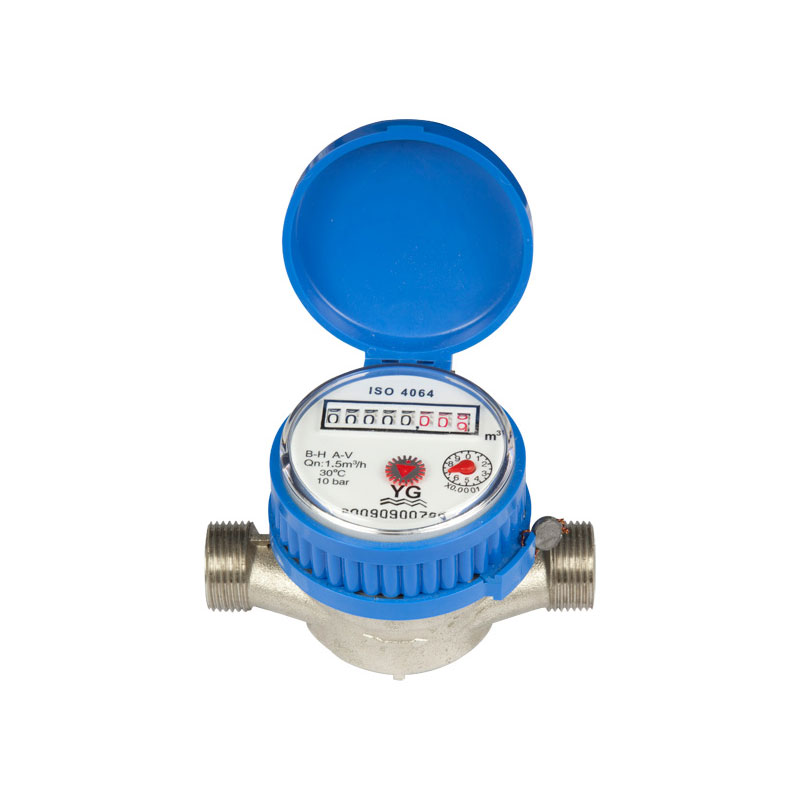
While functioning on the same velocity-based principles as its multi-port counterpart, the internal architecture of a Single-jet Water Meter is fundamentally streamlined. Instead of dividing the incoming liquid into multiple streams, it directs one concentrated jet directly against an internal turbine. The rotation of this single turbine is magnetically coupled to the register. This simplified construction allows the device to be manufactured with a remarkably small footprint, making it incredibly lightweight and efficient.
From a frontline installation perspective, these models shine in specific, space-restricted scenarios. For instance, the Single-Jet Series Water Meter LXSG-13D1~25D1 features a dry dial and magnetic drive, ensuring the internal register remains vacuum-sealed and free from condensation or frost. Built with a robust brass body, it complies with ISO 4064 Class B or Class C standards. It handles a maximum working pressure of 1.6 MPa and is suitable for cold water up to 50 degrees Celsius.
Because of its compact design and lower manufacturing cost, this model is widely considered the optimal choice for secondary tracking, commonly referred to as sub-metering. In sprawling apartment complexes or shared multi-family homes, installing these units on individual supply lines like DN15 or DN20 pipes allows landlords to divide utility costs equitably based on actual tenant usage. They perform exceptionally well in tight utility closets or beneath bathroom vanities where installation space is severely restricted.
Unlike velocity models that calculate usage based on the speed of moving currents, a Volumetric Water Meter utilizes positive displacement technology to physically measure the liquid. The core science involves a specialized internal chamber of a precise, predetermined capacity. As fluid enters, it physically displaces a movable element to pass through to the outlet.
Because the exact capacity of the chamber is known, the device simply counts the number of times it fills and empties. This direct measurement approach entirely removes the variables associated with flow dynamics, ensuring a highly reliable reading regardless of pressure fluctuations.
The standout advantage of this technology in a residential setting is its unparalleled accuracy, particularly at extremely low flow rates. Velocity-based units often struggle to register minor trickles because the fluid simply lacks the kinetic energy required to spin a heavy impeller. In contrast, a positive displacement chamber will accurately capture every single drop. This makes it an invaluable diagnostic tool for detecting minute, silent leaks such as a dripping garden hose or a continuously running toilet flapper. Consequently, many municipal utility companies mandate their use to protect against unbilled non-revenue loss.
A rotary piston mechanism represents one of the most highly engineered variations of positive displacement technology. The internal structure features a cylindrical measuring chamber containing a precisely machined oscillating piston. As pressure pushes into the chamber, it forces the piston to rotate in a continuous, predictable pattern.
Each complete rotation sweeps a specific, fixed volume from the inlet to the outlet. This rotary motion leaves virtually no room for measurement slippage. The decision to utilize this rotary technology is largely driven by its sustained, uncompromising accuracy over a long lifespan. Due to the exacting engineering tolerances, these devices maintain their high-level calibration for many years.
However, this high precision comes with a strict operational caveat. The supply must be exceptionally clean. The microscopic clearances between the oscillating piston and the chamber walls mean that any grit, sand, or heavy pipe scale can easily become trapped. If debris enters the system, it can instantly jam the mechanism and halt flow entirely, making them better suited for treated municipal supplies rather than raw well extraction.
For decades, traditional mechanical hardware has been the undisputed backbone of neighborhood infrastructure. These devices rely entirely on the physical movement of fluid to drive internal gears, which in turn rotate analog dials or an odometer-style numerical display on the faceplate. While they are rugged, operate without the need for an external battery, and are relatively inexpensive, they possess significant limitations in our modern, data-driven era. The most notable drawback is the labor-intensive requirement for manual data collection, which is prone to human error and completely lacks proactive insights for the homeowner.
To address these archaic limitations, the utility sector is undergoing a massive digital transformation. Municipalities are rapidly integrating digital sensors and IoT communication modules into residential hardware. Automated Meter Reading allows utility workers to collect data wirelessly via drive-by receivers. Meanwhile, Advanced Metering Infrastructure utilizes fixed cellular or radio networks to transmit continuous usage statistics.
For the homeowner, the benefits are transformative. These smart systems pair seamlessly with mobile applications, offering real-time tracking and eliminating estimated billing. More importantly, they instantly send push notifications if a continuous anomalous flow is detected at three in the morning, potentially saving thousands of dollars in flood damage.
When selecting a unit for your property, understanding the comparative strengths and weaknesses of each technology is crucial for long-term performance. The table below outlines the primary engineering differences between velocity-based and positive displacement methods.
Meter Technology | Measurement Method | Low-Flow Accuracy | Susceptibility to Debris | Average Lifespan |
|---|---|---|---|---|
Single-Jet | Velocity via single stream | Moderate | Low to Moderate | 10 to 12 Years |
Multi-Jet | Velocity via multiple streams | Good | Moderate | 10 to 15 Years |
Volumetric and Piston | Positive Displacement | Excellent | High requires clean supply | 12 to 15+ Years |
In multi-family dwellings, a single master unit often tracks the usage for the entire building, leaving landlords to divide the bill based on arbitrary square footage estimates. This outdated method inherently discourages conservation. Implementing a dedicated sub-metering system solves this problem. By utilizing compact single-jet or precise positive displacement units on each apartment supply line, property managers can bill for the exact amount consumed. This promotes equitable financial responsibility and heavily incentivizes tenants to promptly report leaking fixtures.
Choosing the correct hardware requires a careful assessment of your unique plumbing infrastructure and peak daily demand. These devices are certainly not one-size-fits-all. To start, grab a flashlight and check the nominal diameter stamped on your incoming copper or PEX pipe. Common residential sizes include DN15, DN20, and DN25.
A standard single-family home with two bathrooms generally operates efficiently with a DN15 or DN20 unit. Conversely, sprawling estates with extensive irrigation systems or multiple high-flow showerheads will likely require a DN25 model to accommodate the higher peak demand. Installing a unit that is too small will severely restrict your shower pressure, while an oversized one will fail to register low-flow usage accurately.
Before you purchase a replacement online or attempt a do-it-yourself installation, it is imperative to understand the strict regulatory landscape governing your local supply. In the vast majority of municipalities, the primary device is the legal property of the city, even though it physically resides on your land. Tampering with or swapping a utility-owned device without explicit authorization is illegal and can result in hefty fines. If you are installing a private sub-meter for tenant billing, you have more freedom. Nevertheless, you must ensure the chosen hardware complies with local plumbing codes and lead-free industry standards.
Understanding the hardware that tracks your daily consumption is an empowering step toward effective property management. By familiarizing yourself with the core differences between velocity-driven designs and positive displacement chambers, you gain valuable insight into how your utility costs are calculated.
While multi-port velocity designs provide excellent durability and cost savings for standard household applications, volumetric mechanisms offer unmatched precision for capturing every single drop of low-flow usage. Furthermore, the rapid integration of smart digital infrastructure is making it easier than ever for homeowners to proactively monitor their environmental footprint.
If you are a property manager looking to implement sub-metering, or a contractor seeking reliable measurement solutions, choosing a reputable manufacturer is critical. We highly recommend exploring the precision-engineered catalog at China Watermeter to find the exact specifications required for your next plumbing project. Upgrading to high-quality, compliant hardware ensures accurate billing, reduces maintenance headaches, and promotes long-term sustainability.
Most mechanical measuring devices have an average operational lifespan of 10 to 15 years. Over time, the internal moving parts such as impellers or oscillating pistons naturally wear out due to continuous friction and mineral scale buildup. As these components degrade, they typically begin to under-register, meaning they record less volume than is actually flowing through the pipes.
Velocity units measure the speed of the current moving through the pipe to calculate the total volume mathematically. In contrast, volumetric models physically capture and measure specific, fixed amounts of liquid within a sealed chamber. Because they rely on physical displacement rather than kinetic energy, volumetric units offer significantly higher accuracy at lower flow rates, making them ideal for detecting minor plumbing leaks.
In most municipal jurisdictions, the city or the local utility company officially owns, operates, and maintains the primary tracking device. The homeowner is generally responsible for all plumbing infrastructure starting immediately after the output connection into the house. However, this rule varies by region and does not apply to private sub-meters installed by landlords for internal tenant billing.
Reading a traditional analog faceplate is similar to reading a car odometer. The main numerical display shows the total volume consumed in either gallons or cubic meters. Read the numbers from left to right. Many models also feature a small sweeping hand for measuring fractions of a unit, and a small triangular or star-shaped low-flow indicator that spins even when a tiny amount of liquid passes through, which is perfect for spotting leaks.
A sudden spike in your billing statement is rarely caused by a malfunctioning measurement device over-registering. Instead, it almost always points to an undetected leak on the property. Common culprits include a continuously running toilet flapper, a dripping outdoor spigot, a malfunctioning irrigation system, or a hidden fracture in the underground supply line leading to your house. Perform a visual inspection and a bucket test immediately to isolate the issue.
If the primary unit belongs to the city or utility company, tampering with, removing, or replacing it yourself is strictly prohibited and can result in severe financial penalties. If the device is a private sub-meter located on your own property for internal billing purposes, you are legally permitted to replace it. In either case, hiring a licensed plumbing professional is highly recommended to ensure proper watertight installation and strict compliance with local building codes.
