

Views: 0 Author: Site Editor Publish Time: 2026-10-05 Origin: Site


Ever stared at an unusually high utility bill in disbelief? You might wonder exactly how that astronomical number was calculated. Hidden plumbing leaks and unmonitored daily usage can silently drain your wallet drop by drop. Acting as the diligent accountant of your home infrastructure, a Residential Water Meter accurately tracks every single gallon flowing from the municipal supply line directly into your property.
Understanding the mechanics behind this vital piece of equipment is not just knowledge reserved for city utility workers. It empowers everyday homeowners to actively monitor their consumption, save money, and diagnose hidden pipe fractures. It also helps you make highly informed technical decisions when a replacement becomes necessary. In this comprehensive guide, we will explore the core engineering behind these devices, examine the various operational types, and provide actionable steps to read your own dial.
Key Takeaways
Core Function: These devices operate as highly precise measurement instruments. They record the exact volume of water used by a household to ensure fair utility billing.
Main Technologies: The industry standard relies primarily on velocity-based mechanisms and positive displacement systems to capture flow data accurately.
Leak Detection: Equipped with incredibly sensitive low-flow indicators, your meter serves as a primary diagnostic tool for identifying hidden plumbing failures.
Smart Upgrades: The modern transition to advanced digital infrastructure allows new units to offer real-time data tracking and automated leak alerts without manual intervention.
Selection Matters: Specifying the correct unit requires an objective assessment of your peak flow rate demands, local municipal regulations, and regional water quality.
At its fundamental core, this highly calibrated mechanical or electronic device sits directly on the main supply line entering a property. Its primary engineering purpose is to accurately quantify the volume of water passing through the public pipe infrastructure into a private residence. This physical measurement is typically recorded in either US gallons or hundred cubic feet. It serves as the empirical foundation for utility billing and household consumption auditing.
For most single-family homes, this equipment is strategically located near the property line. Homeowners can usually find it housed within a heavy concrete or composite plastic box near the street curb. It is buried just below the frost line to prevent catastrophic winter freezing. You might have to clear away some overgrown grass or lift a heavy iron lid to reveal the dial. Conversely, in colder climates or dense urban architectures, the unit may be installed indoors. It is often situated in a basement, crawlspace, or dedicated utility closet exactly where the main pipe breaches the concrete foundation.
Understanding the division of ownership is crucial for both maintenance and legal compliance. In standard municipal utility frameworks, the city or local water purveyor owns and maintains the meter itself. They also manage the supply line leading from the street main. On the other hand, the homeowner assumes full legal and financial responsibility for the plumbing infrastructure extending from the output valve directly into the house.
The fundamental principle behind mechanical water measurement relies heavily on fluid dynamics. Open a faucet inside your home. Immediately, municipal water pressure forces fluid through the main line. It flows directly into the internal chamber of the measuring unit. As water moves through this tightly confined space, it physically interacts with a moving measuring element. This is typically a bladed wheel, a synthetic impeller, or an oscillating piston.
The most critical engineering challenge in designing these units is translating this internal physical movement into readable data without allowing high-pressure water to escape. Modern manufacturers solve this elegant puzzle using a magnetic drive system. The internal measuring chamber contains a strong magnet attached to the spinning element. Directly above it, completely isolated by a solid pressure-resistant barrier, sits the dry register dial. This dial also contains a corresponding magnet. As water turns the internal impeller, the magnetic field rotates. This causes the dry register gears to turn in perfect synchronization. This frictionless magnetic coupling ensures long-term accuracy while completely eliminating the risk of water leaking into the glass dial face.
Operationally, these measurement devices are divided into two primary technological categories. Velocity meters measure the actual speed of the water flowing through a pipe of a known internal diameter. By calculating how fast the fluid moves, internal gearing translates the speed into a volumetric reading. In contrast, positive displacement meters force all incoming water into a precisely sized chamber. The mechanism physically traps a specific volume of water, empties it, and counts the exact number of times this chamber fills. This offers exceptional precision.
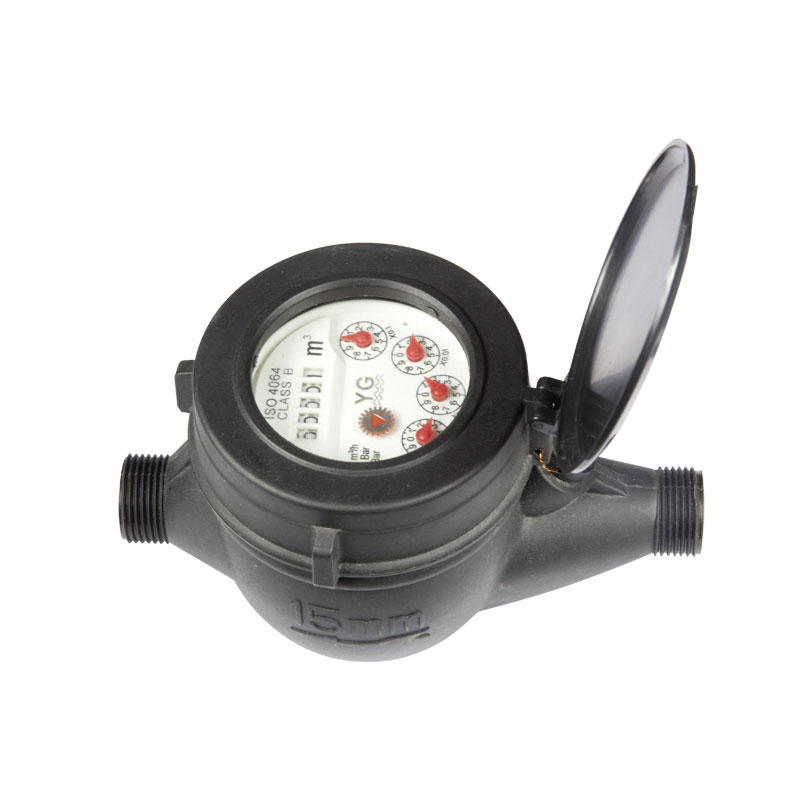
Selecting the appropriate measurement technology depends heavily on local water quality, flow rate requirements, and specific installation environments. Below is a detailed technical analysis of the three most prevalent mechanical designs used in domestic applications today.
Meter Type | Best Application | Key Advantage |
|---|---|---|
Single-jet | Tight spaces, indoor sub-metering | Compact footprint and cost-effective |
Multi-jet | Standard residential mains | High durability, balanced mechanical wear |
Rotary Piston | Strict leak detection environments | Extreme low-flow measurement accuracy |
Operating on a relatively straightforward velocity principle, a Single-jet Water Meter utilizes a single intake port. Water enters the chamber, creating a focused stream that directly strikes the blades of an internal impeller to make it spin. The design is highly compact, mechanically simple, and incredibly cost-effective. It is frequently utilized in secondary sub-metering applications where installation space is severely limited. However, because the water jet strikes only one side of the impeller, the internal bearings are subject to uneven mechanical stress. If the local supply contains high levels of sediment, the single port can become obstructed. This leads to accelerated wear.
Engineered specifically to solve the uneven wear issues found in simpler designs, the Multi-jet Water Meter utilizes a specialized flow-conditioning chamber. Water enters the unit and is seamlessly divided into multiple symmetrical ports that completely surround the internal impeller. This creates multiple jets of water that strike the blades from all sides simultaneously. The result is a perfectly balanced, frictionless spin. For standard domestic applications, the LXSG-15S to 50S series remains an industry benchmark. Available in sizes from DN15 to DN50, these units feature a robust brass or engineered plastic body. They maintain high accuracy classes ranging from R80 to R160. This balanced rotation significantly reduces bearing wear, giving these units an exceptionally long operational lifespan.
Operating entirely differently than velocity-based impeller models, the Piston Water Meter is a positive displacement device. Inside the casing is a specialized cylindrical chamber containing a precisely machined oscillating piston. As fluid enters, it fills the chamber and forces the piston to rotate eccentrically. This pushes a fixed, exact volume of water out with each complete rotation. This design offers unmatched precision, particularly at extremely microscopic flow rates. It can accurately register a dripping faucet that velocity meters might entirely miss. Consequently, it is ideal for environments where rigorous leak detection is paramount. However, its microscopic internal tolerances make it highly susceptible to jamming if sand or grit enters the line.
Recent industry analyses reveal a massive shift in residential water management. Driven by global water scarcity and the urgent need to reduce non-revenue water, municipalities are rapidly upgrading aging infrastructure. The current trend heavily favors the integration of ultrasonic measurement and internet-connected smart networks. These advanced systems provide real-time data analytics.
They allow both utility providers and homeowners to monitor micro-leaks instantly. This shift is not just about billing accuracy. It represents a fundamental move towards sustainable domestic water conservation. Utility companies are moving away from manual readings. Instead, they are investing in automated infrastructure that transmits consumption data multiple times a day. This ensures a more transparent relationship between the supplier and the consumer.
Building on this digital transformation, the landscape of utility measurement is shifting aggressively from purely mechanical systems to integrated data networks.
For decades, standard analog units have relied on purely mechanical dials. To generate a utility bill, a technician had to physically visit the property, open the heavy lid, and manually record the odometer reading. While these mechanical systems are incredibly reliable and require absolutely no external power source, they offer zero real-time data to the homeowner. They also remain prone to human transcription errors.
Advanced Metering Infrastructure takes this a step further. Utilizing cellular, Wi-Fi, or dedicated wireless networks, these digital units transmit usage data to the utility company automatically. This transition directly benefits consumers. Homeowners can now access their consumption data via intuitive smartphone applications or web dashboards. This transparency provides historical usage graphs and completely eliminates estimated billing. Most importantly, it allows for automated leak notifications. If a smart unit detects continuous flow for 24 hours, it can instantly ping the homeowner's phone, preventing catastrophic water damage.
Empowering yourself to read your own Water Meter for Home applications is the very first step in active conservation. By understanding your daily usage, you can audit your consumption habits and verify the absolute accuracy of your monthly utility bill.
Most traditional analog faces look remarkably similar to a car dashboard. The large red or black needle rotating around the dial face is the sweep hand. Depending on the unit of measurement, one complete rotation usually equals one single gallon or one cubic foot of water. Located directly in the center is the odometer. This is a row of numbers recording the total cumulative volume of water that has passed through the pipes since the day of installation. Utilities calculate your bill based on the difference between last month's odometer reading and today's reading.
Crucially, you will also find a low-flow indicator. This is a small, highly sensitive dial. It is often shaped like a triangle, a red star, or a tiny gear wheel. It is specifically designed to detect minute amounts of water movement. If this tiny indicator is spinning, water is actively flowing somewhere on the property.
If your property has been upgraded to a smart digital display, the LCD screen may go to sleep to conserve its internal battery life. To wake the screen, simply shine a bright flashlight directly on the ambient light sensor located on the dial face. Once active, the screen will toggle between the total volume used and the current real-time flow rate. Many digital displays also feature specific diagnostic icons, such as a dripping faucet symbol, that clearly flag continuous non-stop flow.
According to environmental protection agencies, undetected household leaks can waste upwards of 10,000 gallons of water per year. This causes significant financial strain and hidden structural damage. Your measurement device is the most definitive, objective diagnostic tool available for identifying these unseen issues.
To perform an empirical isolation leak test, begin by turning off absolutely every single water source inside and outside the home. This includes all faucets, showers, washing machines, dishwashers, ice makers, and automated lawn sprinklers. Ensure no water is intentionally being drawn. Next, locate your exterior box and observe the low-flow indicator.
If you have completely isolated the plumbing system and the low-flow indicator is still visibly spinning, you have a continuous active leak. The most common culprit is a degraded toilet flapper valve silently wasting hundreds of gallons a day down the drain. If the indicator is not visibly moving, write down the exact numbers on the odometer. Wait for a minimum of two hours, ensuring absolutely no water is used in the house during this period. Check the odometer again. If the numbers have increased even slightly, you have a slow hidden leak. This could be an underground pipe fracture or a weeping solder joint inside a drywall cavity.
Whether you are a property developer outfitting a brand-new subdivision, a landlord implementing sub-metering for multi-family units, or a homeowner replacing a damaged unit, selecting the right equipment requires careful technical evaluation.
Measurement devices are absolutely not one-size-fits-all. Standard domestic sizes range from DN15 to DN50. Sizing must perfectly match the peak flow rate demand of the property, not just the physical pipe diameter. Installing a unit that is too small will create a severe pressure drop. This severely restricts water flow to your showers and modern appliances. Conversely, installing a unit that is too large for normal flow rates will result in the mechanism failing to register low-flow usage. This leads to highly inaccurate data.
You must also carefully assess your water quality and measurement goals. If your municipal water is prone to heavy sediment or hard mineral buildup, a robust multi-jet design is highly recommended. Its balanced mechanics and durability ensure long-term reliability. In contrast, if you require absolute precision for sub-metering in an area with highly filtered clean water, a rotary piston model will provide vastly superior low-flow data capture.
Finally, material safety is non-negotiable. Modern drinking water regulations strictly govern the materials used in plumbing fixtures. Ensure the body is constructed from lead-free brass, engineered composite plastics, or stainless steel. The internal components must strictly comply with health and safety standards. Look for certifications like NSF/ANSI 61, which officially guarantees that the device will not leach toxic heavy metals into your family drinking water supply.
A residential measurement device is much more than a passive mandatory utility requirement. It is an essential active diagnostic tool for proactive home maintenance, accurate utility billing, and ecological water conservation. By meticulously recording every drop of water that enters your property, these robust devices ensure fair financial transactions and provide the critical data necessary to optimize household efficiency.
Whether your property relies on a highly durable mechanical multi-jet design or has recently been equipped with a cutting-edge ultrasonic smart unit, understanding the mechanics behind the dial empowers you to take absolute control of your household water footprint. It allows you to confidently audit your utility bills, identify costly plumbing failures long before they cause structural damage, and make informed technical decisions regarding your plumbing infrastructure.
Take a few minutes this weekend to locate and inspect your home dial. Perform a baseline leak test to ensure your system is perfectly watertight. If you are a property manager, builder, or homeowner looking for reliable sub-metering solutions, prioritize certified equipment. Visit china-watermeter.com to explore a comprehensive range of high-quality measurement devices tailored to your specific flow rate and regional water quality requirements.
In warmer climates, it is typically located near the street curb or property line, housed inside a concrete or plastic box set flush with the ground. In colder regions where freezing is a concern, the unit is usually installed indoors. You will often find it in a basement, garage, or utility closet, positioned exactly where the main water supply pipe enters the foundation of the home.
If the main utility device fails due to age or normal wear, the municipal water provider typically replaces it at no cost to the homeowner. However, if you are purchasing a private sub-meter for a rental unit or guest house, the cost of a standard mechanical unit ranges from $50 to $150. Smart digital models with wireless transmission capabilities can cost between $150 and $400, not including professional plumbing installation fees.
Responsibility is typically divided between the property owner and the municipal utility company. In most jurisdictions, the utility company owns and maintains the primary unit itself, as well as the main supply line leading from the street to the property line. The homeowner is entirely responsible for repairing the plumbing infrastructure leading from the output valve into the house, including the main shut-off valves.
Mechanical measurement devices generally have a highly functional lifespan of 10 to 15 years. Over time, the internal moving parts experience physical wear and tear due to constant friction and waterborne sediment. As these internal components degrade, the mechanism typically begins to under-register the flow. Utility companies proactively replace aging units to prevent this gradual loss of municipal revenue.
It is highly improbable for a mechanical unit to overcharge a consumer. Because these devices operate purely based on the physical displacement or velocity of water, they simply cannot spin faster than the actual volume of water actively flowing through them. When mechanical components wear out, they create friction, which slows the rotation down. Unusually high utility bills are almost always caused by an undetected plumbing leak or an open irrigation valve.
A single-jet model directs one concentrated stream of water against an impeller to measure flow, making the unit compact and inexpensive. However, the one-sided pressure can cause uneven bearing wear over time. A multi-jet model utilizes a surrounding chamber with multiple ports, directing several jets of water evenly around the impeller. This balanced distribution significantly reduces mechanical stress, resulting in higher long-term accuracy under standard residential conditions.
Yes, property owners can legally install private sub-meters on their own plumbing lines downstream from the primary utility connection. This is a highly common practice for landlords who wish to accurately measure the specific water usage of a detached guest house or an individual tenant apartment. However, it is strictly prohibited by law to tamper with, bypass, or replace the primary municipal unit.
