


Views: 0 Author: Site Editor Publish Time: 2026-07-31 Origin: Site


Misclassifying measurement instruments in utility and facility management leads to inaccurate billing, compliance failures, and compromised energy efficiency data. Facility engineers and property managers frequently confuse volumetric flow measurement with thermal energy measurement. This confusion peaks when distinguishing between cold water meters, domestic hot water meters, and true heat meters in hydronic systems. Resolving this ambiguity requires a clear understanding of measurement mechanics. You need to know exactly when to measure liquid volume versus when to calculate thermal energy transfer. Installing the wrong device guarantees skewed data and tenant disputes. This guide breaks down the technical distinctions, material differences, application criteria, and evaluation frameworks required to specify the correct instrument for your mechanical rooms. We will look at the exact hardware differences and operational limits.
Measurement Objective: Water meters measure the physical volume of liquid passing through a pipe (gallons/liters), whereas a heat meter measures the thermal energy transferred within a system (BTUs/kWh).
System Architecture: Water meters are utilized in open-loop systems where the water itself is consumed. Heat meters are required in closed-loop HVAC or hydronic systems where only the thermal energy is extracted and the carrier fluid returns to the source.
Component Complexity: A standard water meter consists of a single flow sensor. A heating energy meter requires three components: a flow sensor, a matched pair of temperature sensors (supply and return), and an integration calculator.
Regulatory Compliance: Selecting the right meter dictates compliance with specific billing regulations (e.g., AWWA/ISO 4064 standards for water; EN 1434 or OIML R75 for thermal energy).
Water meters function by quantifying the physical volume of fluid passing through a pipeline. They rely on mechanical principles like positive displacement, multi-jet velocity, or electromagnetic fields to track flow. The output generated is strictly quantitative, representing total volume over a specific time period. These devices do not account for the fluid's thermal state, density variations, or energy content. Their sole purpose is to measure how much liquid moves from one point to another.
In the field, you will see these installed on domestic mains, irrigation lines, and makeup water feeds. A mechanical water meter uses the kinetic energy of the water to turn an impeller. The rotations translate directly to a volume reading on the register. Electromagnetic versions use Faraday's law of induction to measure the velocity of conductive water across a magnetic field. Regardless of the internal mechanism, the data provided is simply gallons or cubic meters. If you pump 100 gallons of 40°F water or 100 gallons of 180°F water through a standard volumetric meter, the register shows 100 gallons. It ignores the massive difference in thermal energy between those two fluid states.
A Heat Meter operates on thermodynamic principles, calculating energy transfer using the formula: Energy = Flow Rate × Specific Heat × Temperature Differential (ΔT). It requires three distinct sub-components to function correctly. The flow meter measures the volume of the carrier fluid. Thermistors or RTDs measure the temperatures in both the supply and return lines. Finally, the integration calculator processes these inputs to compute the thermal energy transferred.
The term Heating Energy Meter is widely used in the industry to describe devices deployed in district heating, boiler allocation, and commercial HVAC networks. When you install one of these on a chilled water loop or a heating loop, you are not billing the tenant for the water itself. The water simply acts as a conveyor belt for the BTUs. The calculator continuously polls the flow rate and the temperature sensors. It looks at the supply temperature entering the tenant space and the return temperature leaving it. By multiplying the flow rate by the temperature drop and the specific heat capacity of the fluid, it calculates the exact amount of energy consumed.
Feature | Volumetric Water Meter | Thermal Energy Meter |
|---|---|---|
Primary Measurement | Volume (Gallons, Liters, m³) | Energy (BTU, kWh, Joules) |
System Type | Open-loop (fluid is consumed) | Closed-loop (fluid recirculates) |
Required Sensors | Flow sensor only | Flow sensor + 2 Temperature sensors |
Data Output | Cumulative volume | Flow rate, Supply Temp, Return Temp, Energy |
Typical Application | Domestic water, irrigation, makeup water | Chilled water loops, boiler allocation, district heating |
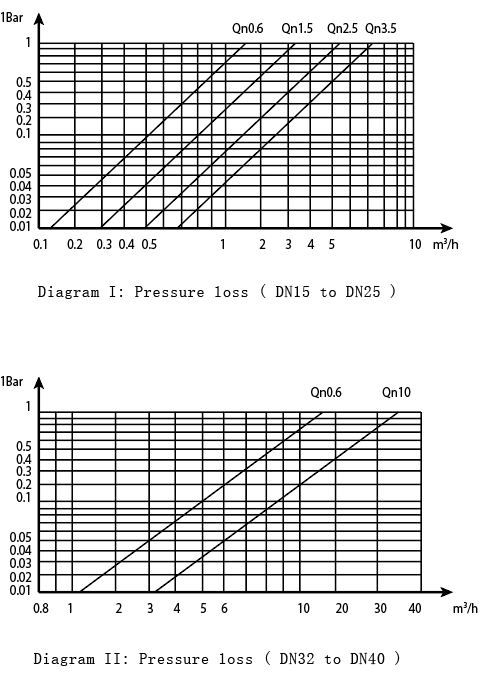
Cold water meters operate within strict temperature limits, typically ranging from 0.1°C to 30°C or 50°C. Domestic hot water meters handle higher temperatures, usually between 30°C and 90°C, with specialized industrial models reaching up to 130°C. Material science dictates these operational boundaries. If you install a cold water meter on a domestic hot water line, the internal plastic components will warp, the seals will fail, and the meter will seize.
Hot water meters demand heat-stabilized polymers, specialized bronze or brass alloys, and high-grade stainless steel. These materials prevent thermal deformation of internal components like impellers and seals. Manufacturers often utilize EPDM instead of NBR for the O-rings and gaskets in hot water applications because EPDM withstands sustained high temperatures without degrading. Additionally, water density changes with temperature. Hot water meters undergo specific calibration adjustments at the factory to account for volumetric expansion at elevated operating temperatures. A gallon of water at 180°F takes up slightly more physical space than a gallon of water at 40°F, and the meter's internal geometry must account for this to maintain accuracy.
A domestic hot water meter measures only the volumetric consumption of hot water used for purposes like showering, washing hands, or culinary activities. It does not measure thermal energy. A heat meter measures the thermal energy extracted from water flowing through a closed-loop system. It is physically impossible to calculate BTU or kWh without measuring the temperature drop (ΔT) between the supply and return lines.
Many property owners make the mistake of installing a hot water meter on a baseboard heating loop, thinking they can bill tenants based on the volume of hot water circulating through their apartment. This fails because it ignores how much heat the tenant actually extracted. Tenant A might leave their windows open, causing a massive temperature drop across their radiators, extracting huge amounts of energy. Tenant B might keep their windows closed, extracting very little energy. If both have the same flow rate, a volumetric hot water meter bills them identically. This is fundamentally inaccurate and often illegal under local utility regulations.
Properties often face tenant billing confusion when utilizing both a domestic hot water meter and a heating energy meter. The domestic hot water meter bills for physical hot water consumed at the tap. The heating energy meter bills for radiator or space heating BTU consumption. Facility managers must clarify this dual-meter scenario to avoid double-charging disputes.
Isolating domestic hot water consumption from hydronic space heating allocation ensures accurate and fair billing practices. You achieve this by physically separating the piping networks. The domestic hot water line feeds the sinks and showers, metered by a volumetric hot water meter. The closed-loop hydronic line feeds the fan coil units or radiators, metered by a thermal energy meter. Clear communication with tenants regarding what each meter measures prevents disputes and ensures compliance with sub-metering laws.
Water meters are essential for sub-metering domestic water consumption in multi-tenant residential or commercial developments. They are also used for irrigation system tracking, process water intake, and municipal water main billing. You specify these when the fluid leaves the pipe and goes down a drain, onto the ground, or into a product.
High low-flow sensitivity to catch dripping faucets and running toilets.
Robust leak detection capabilities integrated into the register.
Tamper resistance mechanisms, including wire seals and magnetic shielding.
Battery life exceeding 10 years for wireless AMR/AMI endpoints.
NSF/ANSI 61 certification for potable drinking water safety.
Heating energy meters are required for district heating and cooling networks, central hydronic boiler systems, fan coil units, and chilled water loops. They facilitate commercial tenant energy allocation by billing for actual thermal energy extracted from the central hydronic loop. You specify these when the fluid stays inside the pipes and simply delivers or removes heat from a space.
Metrological accuracy (Class 2 or Class 3) across narrow temperature differentials (ΔT).
High-frequency calculator processing speed to capture rapid flow changes in variable volume systems.
Compatibility with glycol-based heat transfer fluids, requiring programmable specific heat adjustments.
Matched temperature sensor pairs with strict tolerance limits to prevent calculation errors.
Integration with Building Management Systems (BMS) via hardwired or wireless protocols.
Flow sensors utilize various technologies, including mechanical options like turbine, single-jet, and multi-jet designs, as well as solid-state options like ultrasonic and electromagnetic sensors. Mechanical meters use a physical impeller in the flow stream. While cost-effective initially, they suffer from mechanical wear over time. Debris in the piping system can jam the impeller, and bearing wear alters the calibration curve, leading to under-registration of flow.
Ultrasonic technology is highly preferred in heat meters due to its lack of moving parts. This design minimizes pressure drop, resists scale and rust buildup in heating loops, and sustains accuracy over extended periods. Ultrasonic meters bounce sound waves diagonally across the flow stream. By measuring the time of flight difference between the upstream and downstream signals, the meter calculates the fluid velocity with extreme precision. Because there is no physical obstruction in the pipe, pressure loss is negligible, saving pump energy. Furthermore, hydronic heating loops often contain magnetite (black iron oxide sludge). Magnetite destroys mechanical impellers but passes harmlessly through an ultrasonic flow tube.
Paired platinum resistance thermometers, such as Pt100 or Pt500, are critical components in a heating energy meter. These sensors change their electrical resistance predictably based on temperature. The calculator reads this resistance to determine the exact temperature of the supply and return lines. Minor calibration drifts or unmatched temperature sensors can exponentially distort the final energy calculation.
This distortion is especially pronounced at low ΔT. In a chilled water system, the supply temperature might be 42°F and the return might be 52°F, giving a ΔT of just 10°F. If one temperature sensor is off by just 1°F, your energy calculation is immediately wrong by 10%. This is why temperature sensors for thermal energy meters are manufactured, calibrated, and certified as matched pairs. You cannot replace just one sensor in the field; you must replace the pair to maintain metrological accuracy.
Modern meters must support various communication protocols, including M-Bus, wireless M-Bus, Modbus RTU, BACnet, LoRaWAN, and NB-IoT. Water meters typically transmit simple cumulative volume packets. The payload is small, often just a meter ID, a reading, and a status flag. Heat meters, however, require complex multi-variable payloads.
Protocol | Typical Use Case | Wiring Requirement | Data Payload Capacity |
|---|---|---|---|
M-Bus | European sub-metering | 2-wire bus | High (Multi-variable) |
Modbus RTU | Industrial BMS integration | RS-485 (3-wire) | High (Register mapping) |
BACnet MS/TP | Commercial HVAC control | RS-485 (3-wire) | High (Object oriented) |
LoRaWAN | Campus-wide wireless | None (Battery powered) | Medium (Optimized packets) |
These payloads include flow rate, supply temperature, return temperature, instantaneous thermal power, and cumulative energy data. The integration calculator must format this data correctly for the BMS to read it. When specifying a meter, you must ensure the communication module matches the network architecture of the building. A BACnet MS/TP network cannot natively read an M-Bus meter without a gateway device.
Proper installation requires specific piping configurations. Straight pipe runs upstream and downstream are necessary to stabilize flow profiles. Most ultrasonic meters require at least 5 to 10 pipe diameters (5D-10D) of straight, unobstructed pipe upstream of the flow sensor, and 3 to 5 pipe diameters (3D-5D) downstream. Installing a meter directly after a 90-degree elbow or a control valve creates turbulent flow, which severely degrades measurement accuracy.
Installation rules for heat meter temperature sensors mandate matching probe lengths. Decisions between direct immersion pockets and thermowells must be made carefully. Direct immersion provides faster thermal response times but requires draining the system to replace the sensor. Thermowells allow for sensor replacement without draining the loop, but they introduce a slight thermal lag. Regardless of the method, positioning the sensor tip in the center of the pipe flow ensures accurate temperature readings. If the sensor is too short and sits in the boundary layer near the pipe wall, it will read artificially low or high depending on ambient room temperature.
The regulatory landscape differs significantly between meter types. Water meters comply with ISO 4064 and AWWA standards. Heat meters must adhere to MID Directive 2014/32/EU, EN 1434, or OIML R75. Mechanical water meters generally require replacement or recalibration every 5 to 10 years due to physical wear on the measuring chamber.
Heating energy meters require periodic recalibration or verification of the matched temperature pair and calculator unit to maintain billing legality. In many jurisdictions, you cannot legally bill tenants for energy if the meter's certification has expired. Specifying ultrasonic meters with integrated self-diagnostic and error-logging capabilities reduces manual inspection overhead. These advanced meters can flag issues like empty pipe conditions, reverse flow, or temperature sensor faults, sending an alarm directly to the BMS before billing data is compromised.
The choice between a water meter and a heat meter depends entirely on system function. If the system consumes the liquid, a volumetric cold or hot water meter is required. If the system extracts thermal energy within a closed loop, a heating energy meter is necessary. Using the wrong device leads to catastrophic billing errors and invalidates your energy efficiency data.
Audit the facility's piping architecture to determine if it is an open-loop or closed-loop system.
Identify the required BMS communication protocols for seamless data integration before ordering hardware.
Consult with an instrumentation engineer to size the meters based on nominal flow rates rather than nominal pipe diameters.
Verify the specific heat capacity and glycol concentration of your hydronic loops to program the integration calculators correctly.
A: A cold water meter is designed for temperatures up to 30°C/50°C and uses standard polymer/elastomer internals. A hot water meter is engineered with specialized high-temperature materials like brass, stainless steel, and heat-resistant polymers to handle temperatures up to 90°C or 130°C while resisting thermal wear and maintaining calibration accuracy.
A: No. A hot water meter only measures the physical volume of hot water passing through it. It cannot measure the temperature drop between supply and return lines, which is necessary to calculate thermal energy transfer.
A: Heat meters calculate energy based on the temperature differential (ΔT) between the supply and return lines. Paired, matched temperature sensors ensure accurate measurement of this differential; unmatched sensors introduce errors that distort the final energy calculation.
A: Yes. Ultrasonic flow sensors lack moving parts, which reduces pressure drop and prevents wear from scale or rust buildup common in hydronic heating loops, ensuring sustained accuracy over time.
A: While both can use protocols like M-Bus or LoRaWAN, heat meters transmit more complex data payloads, including flow rate, temperatures, and thermal power, whereas water meters typically only transmit cumulative volume.

